
Welcome to this practical guide bringing together everything you need to play beloved tunes on the thumb piano. You will find free, reliable resources from Instruments du Monde’s “17-Tine Kalimba Sheet Music and Tablature” section: PDFs, videos and tabs for practising this melody and many others.
The path is clear: prepare the instrument, understand the notation and follow a practice plan. The goal is to move from discovery to a fluid performance by combining listening, reading and gradual practice.
We will also cover numbered and letter-note versions, tablature and recommended models for a faithful sound. This guide is for enthusiasts in France who want to explore these film melodies with enjoyment and a clear method.
Why play Disney music on the kalimba today?
Tunes from animated films appeal to every generation and naturally suit the crystalline tone of a small instrument with metal tines.
A simple score makes familiar themes accessible. In just a few notes, a familiar song brings back memorable moments and inspires daily practice.
As a learning exercise, practising a tune you already know makes sheet music easier to read and helps you establish the rhythm. It speeds up learning and improves the precision of your phrasing.
- Accessibility: just a few notes can make a melody recognizable.
- Shared enjoyment: music everyone loves brings family gatherings to life and creates connections.
- Motivation: familiar tunes keep you engaged and open the door to other film music.
| Benefit | Impact | Tip |
|---|---|---|
| Suitable tone | Makes the melody gentle and clear | Choose simple tunes to begin with |
| Easy to read | Quick progress | Start with a short score |
| Emotional value | Brings back memories | Listen to the original before practising |
Prepare your 17-tine kalimba before reading any sheet music
Careful tine adjustment keeps every musical phrase in tune.
Checking the tuning is the first step: even good sheet music will only sound right if the instrument is properly tuned.
Recommended essentials: a tuning hammer, a reference app and an attentive ear for wavering notes.
Simple procedure: check the standard scale of a 17-tine kalimba. Adjust the tines with small movements at the bridge until each pitch is stable.
- Routine: a quick tuning check before each session prevents you from practising on an out-of-tune instrument.
- Signs that adjustment is needed: muddy notes, sustain that is too short or an unstable pitch when a tine is struck.
- Tip: hold and play the instrument consistently to test the tuning reliably.
Record your adjustments on a sheet of paper so you do not have to repeat the same corrections each time.
Finally, listen to the original recording of your chosen song just after tuning. Good tuning makes the exercises that follow easier and learning more enjoyable.
| Step | Action | Expected result |
|---|---|---|
| Initial check | Check the standard scale of the 17-tine model | Identify out-of-tune tines |
| Adjustment | Make small movements at the bridge with the tuning hammer | Stable pitch and clear chords |
| Verification | Test sustain and listen for wavering | Clear notes without pitch fluctuations |
| Routine | Tune before each session | Faster progress afterward |
Understanding kalimba sheet music and tablature
Clear notation makes practice more reliable. Before you begin, identify common symbols: parentheses, ties and note-length markings.
Key symbols
Parentheses often indicate an ornament note or a short repeat. They do not always call for a strong attack.
Ties tell you to sustain a note: do not strike it again; let it ring.
Note-length and phrasing marks convey the character of a pattern. Understanding them helps you avoid rhythmic mistakes.
Numbers, letters and tablature
Numbered notation simplifies the melodic line. Letter notes provide another way to identify pitches. Tablature adds information about tempo, articulation and duration.
“Learn the symbols first, then use the video and metronome to establish the groove.”
- Suggested progression: numbers → letters → detailed tablature.
- Watch a performance video to check how long the notes should last.
- Practise slowly with a metronome and mark fingerings and ties.
| Notation | Use | Recommended level |
|---|---|---|
| Numbers | Quick memorization of the melodic line | Beginner |
| Letters | Clear pitch references | Beginner → intermediate |
| Tablature | Tempo and phrasing details | Intermediate → advanced |
Resources: many free kalimba scores and tabs make learning easier. Alternate between reading, listening and playing until the symbols become second nature.
Disney kalimba sheet music for playing the classics
This selection features memorable tunes ready to download and practise.
The section contains free kalimba sheet music and tablature. Titles include Under the Sea – The Little Mermaid and Up – Married Life. The documents are designed for a 17-tine model and include example videos.
Each title is often available in numbered notation, letter notes and kalimba tablature. These formats suit different skill levels and support steady progress.
Tip: start with a moderate-tempo kalimba song. Move on to a livelier piece such as Under the Sea once you have mastered the rhythm.
- Well-known titles available free without registration.
- Embedded videos for practising rhythm and articulation.
- Consistent notation conventions across the documents.
| Title | Format | Benefit |
|---|---|---|
| Under the Sea (The Little Mermaid) | Numbers / Letters / Tablature | Ideal for working on energy and groove |
| Up – Married Life | Numbers / Tablature / PDF | A good melody for practising expression and phrasing |
| Other film and animation tunes | Various formats | Excellent for developing your ear and progressing step by step |
Tip: compare the kalimba score and tablature to see what information each provides. Arrange the titles from easiest to most difficult so you can progress comfortably.
Under the Sea – The Little Mermaid: a step-by-step thumb piano version
This iconic Disney Studios piece accompanies Ariel’s adventures at a lively tempo. Its melody calls for rhythmic precision and Caribbean-style articulation.
Watch the video to practise rhythm and articulation
Watch the tutorial to understand the offbeats and accents. Two useful French-language vocal references are Henri Salvador’s 1989 version and Christophe Peyroux’s 1998 version.
Simple numbered sheet music for a quick start
The numbered version presents the main melodic line. Practise slowly with a metronome at first, then increase the speed.
Letter-note version for easier reading
Letters help players who prefer an immediate reference for each note. They are useful for memorizing this song.
Detailed tablature to master tempo and dynamics
The complete tablature specifies note lengths, accents and short rests. It is essential for playing the groove accurately.
Download the PDF to play offline
Download the print-ready version and add your fingerings. The blue Gecko is a recommended instrument for this piece.
| Item | Content | Tip |
|---|---|---|
| Resource | Video, numbers, letters, tablature, PDF | Watch the video before reading |
| Vocal reference | Henri Salvador (1989) / Christophe Peyroux (1998) | Listen to both dubs to work on phrasing |
| Recommended instrument | Blue Gecko | Supports projection and clarity |
Under the Sea – The Little Mermaid: download the PDF and begin with short, regular sessions.
Up – Married Life: a complete guide to a beloved melody
This piece by Michael Giacchino rewards careful listening before you try to play it. It won a Grammy and accompanies an opening sequence that moves between happy and sad moments.
Background: the piece comes from a Pixar animated film and draws on a retro style reminiscent of the 1930s. Listen to the original recording to understand its rubato and atmosphere.
Get familiar with the musical context
Start by watching the explanatory video, which illustrates ties and parentheses, then tune the instrument.
Versions and approach
Begin with the numbered score to memorize the melodic line, then try the letter-note version if you find it easier.
Complete tablature and PDF
Study the full tablature to master note lengths and phrasing. A print-ready PDF makes annotation and offline practice easier.
| Item | Purpose | Tip |
|---|---|---|
| Listening | Understand the rubato and expression | Alternate between watching the film and practising |
| Numbers → Letters | Memorize the melody | Start slowly with a metronome |
| Tablature | Note lengths and ties | Isolate difficult phrases |
| Instrument | Projection and sustain | LingTing K17A in padauk recommended |
“Practise with a metronome, isolate difficult passages and record yourself: it is a simple, effective approach.”
Tuning your kalimba: the foundation for accurate melodies
Stable tuning immediately improves the sound and builds confidence during practice.
Start with a reliable reference: a tuning app, tuning fork or electronic tuner. For a 17-tine model, follow the standard scale and compare each note with the reference.
Before playing a kalimba score, run a quick test: play the full scale. Check that the notes are clear, the pitch does not waver and the sustain is even. If a tine shifts or sounds out of tune, correct it with very small movements at the bridge.
Quick routine before each session: play the scale → adjust one or two tines → listen again → confirm. Then listen to a few seconds of the original recording to prepare your ear before reading the music.
Keeping a record of your adjustments helps when you travel or humidity changes. A well-tuned instrument brings out its natural vibrato and makes pitch differences easier to hear during rhythm practice.
With this simple routine, your scores come to life and learning animated-film pieces becomes smoother.
| Action | Why | Expected result |
|---|---|---|
| Reliable reference | Allows accurate tuning | Stable pitch |
| Scale test | Reveals wavering notes and unstable tines | Clear sounds and even sustain |
| Small adjustment at the bridge | Corrects the pitch without damaging the instrument | Accurate pitch restored |
| Adjustment record | Keeps track of corrections | Quick tuning while travelling |
For a practical example and tuning guidance, see the page for Up – Married Life (kalimba sheet music).
Choosing notation: numbers, letters or tablature for your level
Depending on your level, the same tune may be easier to read in numbers, letters or tablature. The two song pages offer all three formats. Simplified versions help you grasp the melody quickly.
Quick comparison:
- Numbers — ideal for getting started and memorizing the main line.
- Letters — easier to read if you use pitch references.
- Tablature — shows tempo, duration and dynamics for a faithful performance.
If the rhythm remains unclear, switch to kalimba tablature. If you want a quick first outline, stay with numbers or letters.
Suggested path: numbers → letters → tablature. Alternate between reading and watching the video to fill in what the notation does not show.
| Format | Benefit | When to use it |
|---|---|---|
| Numbers | Quick reading | Beginner, first attempt |
| Letters | Pitch references | Intermediate learning |
| Tablature | Rhythmic details and ties | Intermediate → advanced |
Mark fingerings and places to breathe on your PDF. This builds independence and makes the next stages of learning easier.
With sheet music suited to your level, every piece becomes approachable and rewarding.
Rhythm and tempo: improving on fast animated-film songs
Mastering tempo and pulse makes a fast tune easier to play.
Break the melody into short rhythmic patterns. Practise each one separately until the pulse is steady.
Start very slowly with a metronome and gradually increase the speed. This approach prevents imprecision in a fast score.
Sing the melodic line before playing it. Singing helps you absorb the accents of film music naturally.
“It is better to play a little accurately: slow repetition helps you reach the right speed.”
- Simple routine: 5 minutes clapping the offbeats → add the notes → practise the ties.
- Identify difficult passages, such as syncopations and triplets, and repeat them in a loop.
- Record yourself to check rhythmic consistency from one session to the next.
| Step | Duration | Goal |
|---|---|---|
| Clap the rhythm | 5 min | Steady the offbeats |
| Slow → fast metronome | 10 to 20 min | Establish each pattern |
| Focused work on difficult passages | 5 to 10 min | Correct syncopations and triplets |
One last tip: alternate a lively piece with a slower tune in your practice plan. Patience and a clear method can turn a difficulty into a musical strength. For printable resources for 17-tine models, see these 17-tine sheet music resources.
Kalimba playing techniques: thumbs, transitions and fluidity
Mastering your attack and thumb position immediately improves a melody’s clarity.
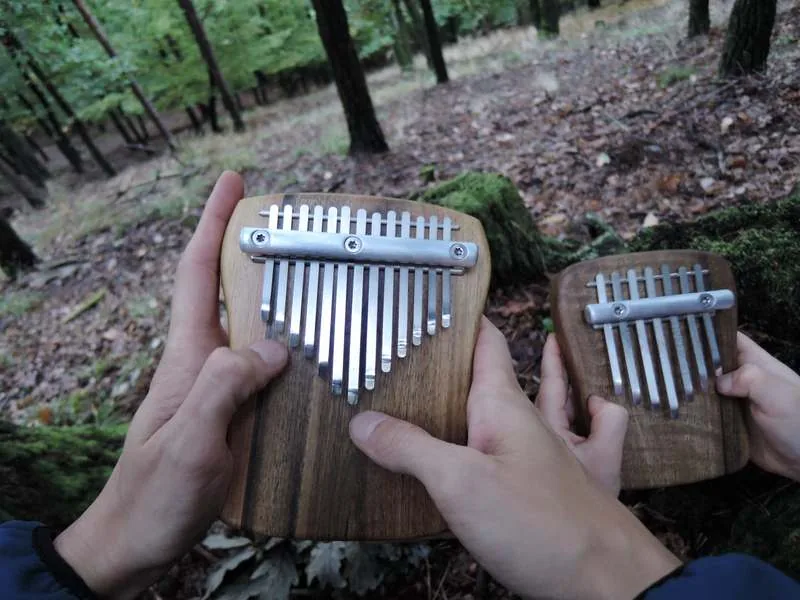
Thumb agility and tine control
Hold the instrument steadily, with relaxed wrists and slightly angled thumbs. Strike each tine near its end for a clear sound.
When moving between nearby tines, anticipate the motion: small adjustments to your attack and timing prevent unwanted noise.
- Alternating-hands exercise: 8 slow repetitions, then gradually speed up.
- Fingerings: mark them on your kalimba score before practising with a metronome.
- Arpeggios and ostinatos: two short patterns steady the hands and enrich your phrasing.
Relax your muscles between phrases. This prevents fatigue and improves later practice sessions.
“A precise attack gives both thumbs an even volume and creates a singing melodic line.”
Explore dynamics (pp → ff) and articulation (legato, staccato) in short excerpts. Alternate technical exercises with passages from your scores to keep the musical expression in focus.
| Goal | Repetitions | How to check |
|---|---|---|
| Thumb agility | 3 × 8 min | Compare recordings |
| Smooth transitions | 5 repetitions per phrase | Reach the target tempo |
| Dynamics and phrasing | 2 × 5 min | Listen critically |
Weekly benchmarks: set a target tempo and number of repetitions, then check your progress with a recording. You will improve from one piece to the next while developing your musicality.
Other animation classics to explore with your scores and tabs
Exploring other musical worlds opens up new sounds. The collection offers plenty to discover: Ghibli, Your Name, Zelda, Star Wars, Harry Potter and Game of Thrones.
From Disney and Pixar to other works: broaden your repertoire
Go beyond familiar hits to vary the styles you play and practise different kinds of phrasing.
- Suggestion: alternate a Western film theme, a Ghibli piece and an anime song.
- A striking example: Tokyo Ghoul – Unravel is among the free scores and offers a useful rhythmic contrast.
- Video game and television melodies expand your range of sounds and techniques.
Set quarterly goals: master 3 pieces (film, Ghibli and anime) and make a final recording. Record the tempos you reach and the sections you have mastered to track your progress.
“Choose pieces that suit your level to stay motivated and avoid frustration.”
| Action | Purpose | Tip |
|---|---|---|
| Alternate styles | Develop your ear | One Disney / one Ghibli / one anime piece (such as Tokyo Ghoul) |
| Track your work | Measure progress | Record tempos and sections mastered |
| Reading method | Build on what you have learned | Move from numbers to letters, then tablature |
Tip: reuse the same reading principles and revisit each melody regularly. Free kalimba scores let you try new musical worlds quickly.
Reliable, free resources: kalimba sheet music and tablature
One central source makes searching easier and keeps the documents consistent.
The Instruments du Monde store brings together files for 17-tine models. Everything is available free without registration. The documents combine numbered versions, letter-note versions and kalimba tablature, supporting step-by-step learning.
Benefits: consistent notation, editorial quality and embedded videos for each title. The videos help coordinate what you see with what your hands play.
- Save time: search by name and filter by category and version.
- Teaching use: print, annotate and share with a teacher.
- Personal library: save and organize your files by theme (Disney, Ghibli, films).
| Strength | Impact | Tip |
|---|---|---|
| Completely free access | No barrier to entry | Build an archive |
| Multiple formats | Progress suited to your needs | Alternate numbers, letters and tablature |
| Videos | Visual learning | Watch before playing |
In short: a reliable source supports progress and keeps you motivated. To begin, explore the free sheet music and tablature and set up your practice plan.
Learning videos: coordinate your eyes and hands
Watching a demonstration speeds up thumb piano learning by connecting what you see with what you play.
Use the video to observe the movements: thumb position, attack and note length. Find the strong beats and match the movements you see to your kalimba score.
Alternate watching with pauses. Watch a passage, pause the video, play it on your thumb piano, then resume. This step-by-step method helps you master difficult transitions.
- Listen twice: compare the instrumental performance with the film original to find the tempo and expression.
- Highlight the cues you see on screen, such as syncopations and accents, in your scores and tabs.
- Use YouTube’s slow playback if needed to study the movements in detail.
For example, in Under the Sea – The Little Mermaid, the visual demonstration helps you place the syncopations and accents.
Record your own performance to compare your angle of attack and consistency. Good headphones reveal subtle details and improve precision.
“Video supports practice: make it part of your routine.”
Useful downloads: build your PDF library
A well-organized library makes even ten minutes of practice productive.
Both song pages offer free PDFs containing numbered notation, letter notes and tablature. Downloading these files lets you practise offline and annotate them directly.
Practical tip: organize your files by film, animation or difficulty. Create three folders: “in progress,” “to review” and “mastered.”
- Keep a clean copy and an annotated copy of each kalimba score to track your development.
- Mark fingerings, ties and your target tempo directly in the PDF.
- Sync your library to your phone and tablet so you can practise anywhere.
With all your documents available offline, you can keep practising without an internet connection. Well-organized scores make every short session productive.
Example: start with the Under the Sea PDF to try downloading and annotating a score.
| Action | Purpose | Result |
|---|---|---|
| Download the PDF | Practise offline | Immediate access without the internet |
| Annotate | Add fingerings and a target tempo | More focused sessions |
| Organize | Structure the next stages of learning | Productive 10-minute sessions |
| Back up to the cloud | Preserve your work | No lost files |
“Keeping a clean version and an annotated version helps you measure your progress.”
Choosing equipment: recommended kalimbas for a faithful sound
A well-chosen instrument makes playing and improving easier. Before buying, check its tuning accuracy, sustain, projection and comfort in your hands. These qualities directly affect how you play a score and shape each phrase.
17-tine Gecko kalimba: this blue model offers a clear tone and quick response. Its precision is especially suited to the syncopations in “Under the Sea” and other rhythmic passages.
LingTing K17A in solid padauk: this dense wood provides greater projection and a rich legato. The model is recommended for Married Life and classically inspired arrangements.
A responsive instrument makes playing from a score more predictable. The initial investment can prevent technical difficulties, especially in older pieces that call for subtle changes in tempo.
- Criteria: tuning accuracy, sustain, projection, comfort and tine quality.
- Simple care: remove dust, check the tines regularly and verify the tuning.
- Try several models and note your impressions of resonance, attack and comfort.
| Model | Strength | Use |
|---|---|---|
| 17-tine Gecko | Clear tone, crisp attack | Syncopations and lively pieces |
| LingTing K17A in padauk | Projection and legato | Lyrical phrasing and classical music |
| Criteria | Tuning accuracy and sustain | Reliable performance from sheet music |
For a detailed comparison and an example of its use on Married Life, see the site’s dedicated page.
Weekly practice plan: from discovery to performance
Five short, focused sessions are enough to memorize a new melody.
A sample plan: 20 minutes a day for 5 days, working on two scores in parallel. Alternate reading, technique and musical expression to stay motivated.
Day 1 — discovery: listen to the original and slowly read through a page of sheet music.
Day 2 — technique: practise transitions and ties with a metronome at a very slow tempo on this melody.
Day 3 — video: watch a learning video, mark fingerings and incorporate accents and ties.
Day 4 — consolidation: link sections together and make a short recording for feedback.
Day 5 — performance: play the whole piece, paying attention to tone and expression. Prepare the next set of goals.
A little but often: short five-minute sessions throughout the day strengthen muscle memory.
At the end of the week, add an easy song from your repertoire for enjoyment and to measure your progress.
| Day | Goal | Expected result |
|---|---|---|
| 1 | Listen and read through the music | Identify difficult passages |
| 2 | Focused technique | Fluidity in short patterns |
| 3 | Video and annotation | Confirmed fingerings |
| 4 | Consolidation | Accurate transitions |
| 5 | Performance | A short performance |
Record the tempos you reach, the difficulties you resolve and the points you need to revisit. A structured plan turns motivation into concrete, lasting results. At the end of each cycle, create a new set of exercises and repeat the process: progress comes step by step, and each one makes a difference.
Conclusion
To close, remember the essentials that turn practice into living music.
Prepare the instrument, master the notation and choose a suitable format. With free sheet music and videos, anyone can approach this melody and this song with confidence.
A repertoire drawn from major studios and composers creates a direct connection to wonderful films. Thumb technique, ties and rhythm will serve you in every future score.
Download the PDFs, plan short sessions, record yourself and tune your instrument regularly. Your sound will improve, and playing for loved ones will create happy memories.
Thank you for reading: come back to expand your library and nurture your playing every day.