
This article traces the journey of a plucked-tine instrument, from its earliest plant-based tines to modern models. We follow more than 3,000 years of development and show how it spread around the world and into contemporary music.
In brief, it has two origins: bamboo prototypes on the west coast of Africa, followed by metal-tined instruments that appeared in the Zambezi Valley about 1,300 years ago. The first European account dates from the late sixteenth century and provides a useful historical reference point.
Rituals, celebrations and private music-making have all shaped the instrument’s social life. In the 1950s, Hugh Tracey standardized a diatonic model and distributed it widely. Later, popular artists helped bring it to a global audience.
To learn more about these stages and recent developments, follow our detailed account and consult this comprehensive source: the instrument’s origins and evolution.
The origins of an iconic African lamellophone
At the roots of this idiophone are vibrating tines and resonators designed to carry their sound.
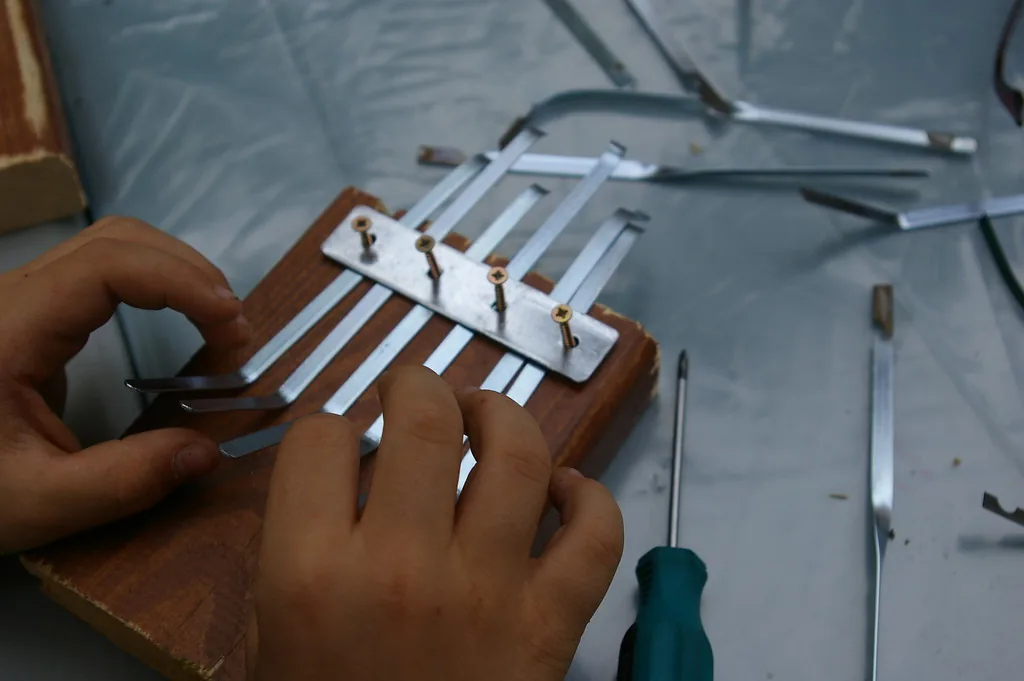
An instrument in the lamellophone family produces sound when tines of different lengths vibrate. The tines are fixed to a board or wooden box and plucked mainly with the thumbs.
The resonator box increases the volume and enriches the tone. Sometimes a simple board takes the place of the box; the acoustic principle remains the same.
Models range from five or six tines to more than twenty in elaborate versions. This technical variety reflects the richness of the instrument’s forms and uses across the continent.
Names vary across linguistic regions: mbira, likembe and sanza all attest to a long cultural history. To see a contemporary model, explore this African sanza instrument.
“Sound comes from the vibration of the tines and the body; a simple design conceals great expressive range.”
Two beginnings: from bamboo to metal across the centuries
On the west coast of Africa and later in the Zambezi Valley, two technological paths help explain the diversity of forms. The earliest archaeological traces place the instrument about 3,000 years ago, with bamboo or rattan tines in what is now Cameroon.
These plant-based models left few traces because their materials decay quickly. Surviving artifacts are rare and fragmentary.
About 1,300 years ago: metal tines in the Zambezi Valley
Later, about 1,300 years ago, instruments with metal tines appeared in the Zambezi Valley. The shift to metal brought greater durability, more stable tuning and stronger sound projection.
- Greater durability: the tines retain their shape and sound for longer.
- Acoustic quality: more volume and more stable tuning.
- Technical context: the Iron Age made the use of metal possible.
“The lack of a direct material link between the two regions strengthens the theory of two independent inventions.”
These two origins help explain why the instrument has so many variants across the continent. The evidence remains incomplete; ethnomusicological studies and written sources, including those on its historical development, help fill the gaps and lead us to the first European accounts.
Early written records and European accounts from the sixteenth century
A Portuguese source from the early seventeenth century sheds light on the instrument’s documented presence in East Africa.
1586–1607: Father João dos Santos and a nine-tined “ambira”
João dos Santos, a Dominican missionary, stayed in the region (Mozambique, Zimbabwe and Malawi) from 1586 to 1597. In his 1607 book, he describes an ambira with nine iron tines fixed to a wooden support.
He notes that it was played with long fingernails and produced soft and pure sounds suited to intimate settings. His account is among the earliest European written records of a thumb piano.
| Element | Description | Significance |
|---|---|---|
| Observation | Nine iron tines on a wooden support, played with the fingernails | Evidence of use in East Africa in the sixteenth century |
| Terminology | Term used: “ambira” | A reference point for European accounts |
| Reception | Appreciation of its tone in an intimate setting | European fascination with Indigenous music |
| Musicological value | Helps fill gaps in the archaeological record | Helps interpret tunings and playing practices |
Together, these written accounts confirm that the instrument was present and played. Other explorers later published descriptions that added to this record.
For educational and visual sources, consult this educational resource, which is useful for researching the instrument’s spread and varied forms.
Mbira, kalimba, likembe: one instrument family, many roles
Among different peoples, this group of instruments serves a wide range of social and sacred functions. The family includes different sizes, tunings and uses. Some versions are played at celebrations; others hold deep ceremonial significance.

The Shona people: mbira dzavadzimu and communication with ancestors
Among the Shona of Zimbabwe, the mbira dzavadzimu often has 21 to 25 tines. This instrument is sacred and plays a central role in ceremonies.
It is used to call on ancestors and communicate with them. Its extensive repertoire and number of tines allow for rich harmonic textures.
Social and personal uses: rituals, celebrations and singing
Smaller variants with 6 to 10 tines accompany singing, storytelling and everyday life. They may be used alone or in groups.
In rituals and family gatherings, the instrument is combined with voices, percussion and sometimes a calabash resonator. These practices sustain memory, cultural transmission and identity.
“The instrument is more than music: it carries memory and creates social bonds.”
Hugh Tracey and modern standardization in the 1950s
In the 1950s, a systematic effort turned a local instrument into a teaching tool distributed around the world. Hugh Tracey, a dedicated ethnomusicologist, organized field collections and studies. His aim was to create a model accessible to Western audiences.

From fieldwork to a model: a diatonic scale and 15 tines
Hugh Tracey designed a standard 15-tine model tuned to a diatonic scale, initially in G major. This made its notes compatible with Western musical systems.
A Western-adapted design: hollow body and projection
The prototype replaced a simple board with a hollow box pierced by a central sound hole. This resonator box increased projection and enriched the sound.
International distribution and legacy
Tracey founded AMI (African Musical Instruments) and worked with publishers such as Creative Playthings to distribute the model. Its metal tines evolved into plated spring-steel tines, improving tuning stability.
Andrew Tracey continued the work of documentation and teaching, developing a repertoire and educational methods. The instrument thus became more standardized and reached new markets.
“Standardization made structured teaching possible while local traditions continued to thrive.”
| Aspect | Before 1950 | Innovation (1950s) | Result |
|---|---|---|---|
| Number of tines | Variable (5–25) | Fixed at 15 tines | Consistency for teaching |
| Tuning | Local modes | Diatonic (G major) | Compatibility with Western sheet music |
| Structure | Board or simple box | Hollow box with a central sound hole | Better projection and resonance |
| Materials | Various tines | Plated spring steel | Stable tuning and industrial production |
To explore its modern influence and educational uses, consult this resource on distribution and tradition: African music and modernity.
Kalimba origins: the history of the African thumb piano in the modern world
From American folk stages to major pop productions, the twentieth century made this instrument a global phenomenon.
Growing popularity in the twentieth century
Its spread accelerated in the 1960s through specialist magazines and independent music scenes. The wider public encountered it when Earth, Wind & Fire featured it in the notable track A Kalimba Story (1974).
Hugh Tracey was a key figure in this development: his fieldwork and teaching model helped people learn the instrument and spread it worldwide.
Technical and sonic innovations
A standard 17-note model in C major became widespread, while chromatic models expanded its harmonic possibilities.
Materials and designs changed too: bodies are made from wood (mahogany, walnut or acacia) or acrylic for a modern look. Metal tines retain the clarity of each note’s attack and influence the instrument’s tone.
Brands, makers and choosing a model
Companies such as AMI, Hokema, Gecko and Hluru offer models, accessories and instruction booklets. Signs of quality include stable tuning, projection, finish and comfort for the thumbs.
“Contemporary uses draw on a balance between a 1,300-year heritage of metal-tined instruments and ongoing innovation.”
From one continent to another: current practices and living heritage
The musical journey continues: the instrument now has a place in workshops, classrooms and therapeutic practice.
Music therapy, music education and modern creativity
Practitioners, teachers and therapists use the instrument for its gentle vibrations and soothing tones.
In music therapy, its ease of use helps people engage with sensation and rhythm. Patients can quickly feel the vibrations and resonance produced by its wooden body.
At school, it introduces students to sound, tempo and active listening. Instrument makers and educators offer methods, repertoire and workshop formats suited to beginners.
UNESCO 2020: recognition and transmission
In December 2020, UNESCO inscribed the art of crafting and playing the mbira on its intangible cultural heritage list for Malawi and Zimbabwe.
“This recognition honors craftsmanship, the passing on of knowledge and the instrument’s social role in ceremonies and connections with ancestors.”
Heritage and innovation coexist: online communities and resources make the instrument accessible worldwide. Its journey from local traditions to contemporary uses confirms its global reach.
Conclusion
From the first bamboo tines to metal ones, the instrument’s development reveals a living connection between past and present.
In brief, its history includes two beginnings, European accounts from the sixteenth century and standardization in the 1950s. Its construction — tines, body and tuning — explains its rich range of tones
, while this instrument family also holds cultural roles in rituals and social life and continues to inspire modern musicians.
To make an informed choice, check the materials, tuning stability and finish. For more information, read our complete guide.
UNESCO’s recognition in 2020 is a reminder of its heritage value. Today, the instrument remains a living tradition on the African continent and beyond, rich in vibrations, accessible and full of musical possibilities.