
Goal: this step-by-step guide teaches you to play the main theme on a 17-tine instrument tuned to C major. The method is clear, gradual, and designed to prevent frustration.
What you need: a 17-tine instrument, a tuning hammer, a tuner (or mobile app), and, if possible, stickers to identify the notes.
What you will learn: how to read the numbers 1 to 7, identify sharps and octave dots, and play the intro before moving on to the verse and chorus at a manageable tempo.
Steps: prepare the instrument, review the basics of reading notation, work through the tutorial section by section, manage the rhythm, and use resources to improve. No musical background is required.
Practical approach: practice in short loops, use a metronome, and record yourself to improve note clarity and consistency.
Expected result: by the end, you will be able to play the main theme, understand passages with sharps, and keep a steady tempo.
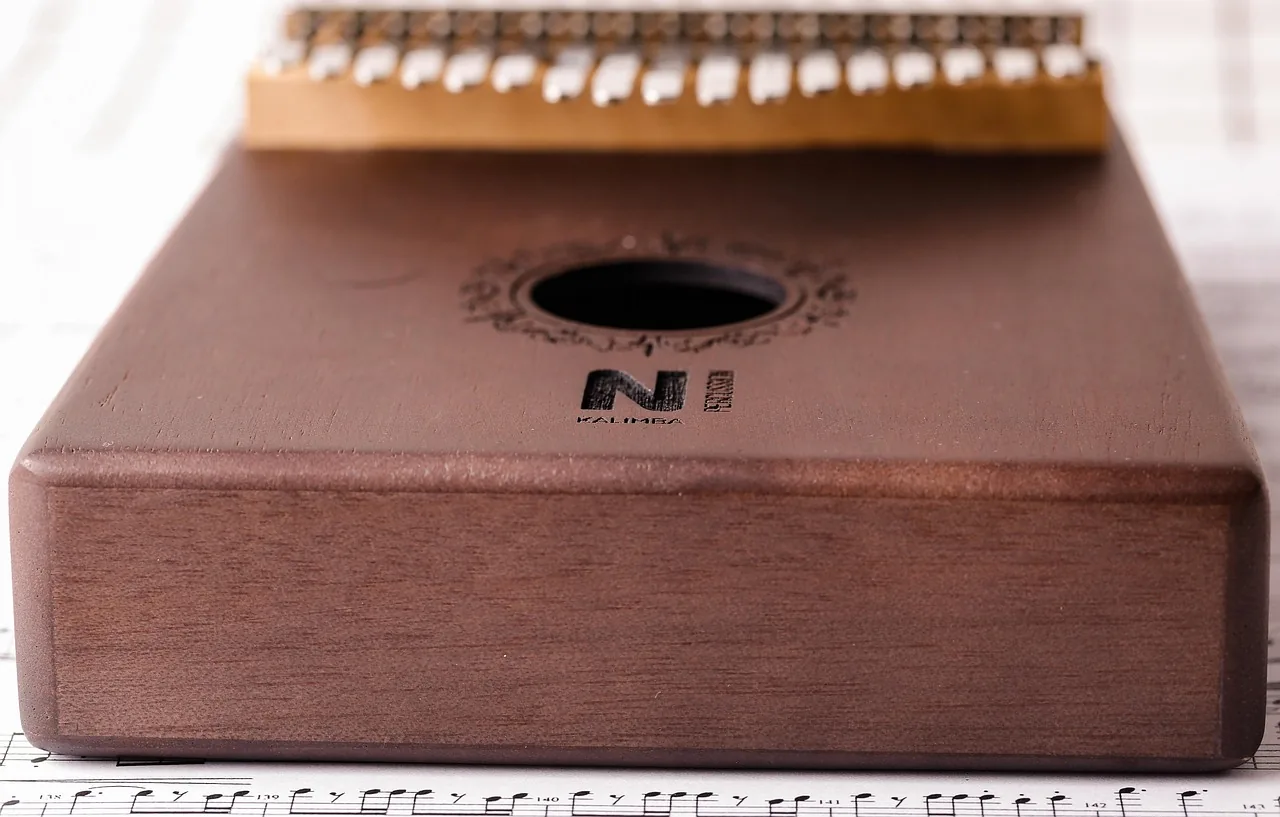
Further down this article, each page of the guide will show an illustration of the instrument’s anatomy and how to hold it, which is useful even without printed sheet music. You will also find exercises and an explanatory image to make learning easier.
Getting started with the kalimba in France today: why this instrument is ideal for beginners
Learning quickly becomes rewarding. The instrument produces a sound straight away, which gives players confidence. Progress is achievable and avoids early frustration.
Numbered notation (1 to 7) makes reading easier. It is more intuitive than traditional music notation and works well with tabs and simplified sheet music.
Its portability and low volume make this instrument ideal for playing at home in France without disturbing the neighbors. Reasonably priced 17-key models with a case and tuning hammer are available.
French-speaking and international communities answer questions in forums, groups, and articles. Well-reviewed pages and books can help you build a small collection of learning resources.
- Versatility: film melodies, pop, lullabies, and traditional songs.
- Affordability: a lower budget than for other instruments, with bestselling bundles available.
- Simple accidentals: sharps and octaves are marked in numbered tabs.
| Benefit | In practice | Resource |
|---|---|---|
| Speed | Your first piece in a few sessions | Step-by-step guide (dedicated page) |
| Price | 17-key bundles with a case included | Books and songbooks (user reviews) |
| Community | Forums and groups where you can ask questions | Articles and tutorial pages |
Set yourself a specific first goal, such as following this guide. With short sessions, you can soon play a complete piece and build a lasting routine; the reference “12.72 below” may serve as a marker.
Prepare your kalimba before playing “Kalimba de Luna”
Good tuning and a comfortable grip make every note clearer from the first session.

Anatomy and grip
The 17-key version has metal tines attached to a wooden body. You can identify the bridge and the nut. A tuning hammer is often included with the instrument.
Hold the instrument in your palms. Play the tines with your thumbs by pushing them upward. Keep your wrists relaxed and hold the instrument at a comfortable height.
C major tuning and a tuning routine
Standard C major tuning places middle C in the center, with the remaining notes alternating between left and right. Use a tuning app to check the pitch.
Routine: tune the central tines first, then work symmetrically outward. Check the tuning again after a few minutes, as the metal may shift.
Reading sheet music and first exercises
The numbered system uses 1 = C … 7 = B. One dot above a number indicates the higher octave (1°); two dots indicate two octaves (2°°). A sharp is written as # (for example, 4# or 4°#).
Groups in parentheses (135) indicate an arpeggio or a glissando. Play the scale from 1 to 7, then 1°, slowly and clearly with a metronome.
| Part | Function | Practical tip |
|---|---|---|
| Tines | Produce the sound | Check the pitch and clarity of the sound |
| Tuning hammer | Adjust the note’s pitch | Tap the bottom to raise it and the top to lower it |
| Tuning apps (Tuner) | Accurate tuning | Tune the central tines, then the outer ones |
Kalimba de Luna: beginner kalimba tutorial
This section explains how to learn the piece in simple, gradual steps.
Sections, tempo, and opening pattern
Divide the piece into three parts: intro, verse, and chorus. Start at 60 to 70 BPM and increase the tempo only when you can play clearly.
Repeat the opening pattern in a loop: 5 6 7 2° 6° 5° 2° 6° 5°, followed by 2° 2° 1° 1° 5 5 6 5 4#. Focus on striking each tine cleanly with your thumb.
Fingering and thumb placement
Use your right thumb for the tines on the right (common high notes: 6°, 7°, 2°) and your left thumb for the tines on the left (5, 6, 7).
Keep your thumbs close to the tines and play at a consistent angle to avoid unwanted vibrations and maintain an even volume.
Sharps, octaves, and transitions
Locate the altered notes (4# / 4°#) and practice these transitions slowly. Work through the following sequence in small groups of notes: 7 2° 6° 5° 2° 6° 5° 2°° 6° 5°, then 4°# 3° 2° 1° 7 6 5 2.
Rhythm, phrasing, and common mistakes
Use ties and glissandos sparingly to imitate the singing. Pause briefly between patterns to let the melody “breathe.”
- Method: read aloud, practice each hand separately, alternate hands, link the notes slowly, then increase the tempo by 5 BPM.
- Common mistakes: thumbs held too high, uneven pressure, and confusion between octaves. To correct them, lower your thumbs, use a metronome, and check the octaves.
Follow the link to view a detailed tab excerpt and discover useful tools. Record yourself to balance the hands and identify passages to improve.
Recommended resources, sheet music, and equipment for improving
To make steady progress, choose reliable books, well-tuned instruments, and a few useful digital tools.
Books and songbooks: look for well-reviewed paperback methods. Examples include “Méthode Coup de pouce kalimba” (Denis Roux, paperback, 4.3/5 from 37 reviews) and “Le livre du kalimba” (Quentin Hannappe, paperback). Thomas Balinger’s songbooks offer a broad repertoire (rated 4.5/5 and 4.2/5, depending on the edition).
Songbooks and bestsellers
Choose songbooks organized by difficulty. Bestseller labels can help you narrow the selection and avoid buying books with pages you will not use.
Recommended instruments and accessories
Seventeen-key models such as the Moozica K17K, or Newlam bundles (ranked number one among bestsellers), offer stability and accessories such as a case, hammer, and stickers.
Online tools and where to find tabs
Use a Tuner, Tab Converter, and Tab Maker to adapt sheet music. Look for tabs on specialist sites and check their notation (octaves and sharps) to avoid unrelated sponsored articles.
| Resource | Use | Buying tip |
|---|---|---|
| CRB Ventures guide | Tuning and exercises (114 pages) | Check the dimensions and user reviews |
| Balinger songbooks | Gradually expanding repertoire | Choose according to difficulty |
| 17-key bundle | Portable practice | Compare prices and accessories |
How to buy: compare prices, preview pages, and user reviews before ordering. To find reliable tabs, consult specialist resources and a detailed example such as this dedicated tab.
Build a small library: one method book, one or two songbooks, and a care guide. Record your progress (tempo and difficulties); the “12.72 below” marker will help you track your goals. Review your choices at the “23.02 below” and “24.24 below” markers and adjust them as needed.
Conclusion
What you have learned: you can tune the instrument to C major, read numbers with octave dots and sharps, play the intro, and then move through the verse and chorus with careful phrasing.
Strengthen your skills by repeating the opening pattern at a slow tempo, then gradually increasing your speed. Record a complete performance to assess your consistency and musicality.
Next, choose a second song at the same level, then a slightly more complex piece that focuses on altered notes. Alternate guided practice (with a good guide and books) with work on your repertoire.
Care: check the tuning, gently clean the body, and inspect the screws. Share your questions and progress on community pages.
Need more exercises? See this additional resource: another tutorial.
Remember: consistency is essential. The “12.72 below” and “23.02 below” markers will help you track your progress.