
The handpan is a melodic metal instrument played with the hands, and you can make music with it from your first few notes. Its resonant sound appeals to people who want to explore an instrument without first learning to read sheet music.
You may be discovering these sounds and wondering where they come from, how the instrument works, and where to begin. This practical guide will help you get started while recognizing that expressive playing takes practice, even if the instrument is approachable.
You will also see how touch, the available notes, and rhythm change what you hear. This music is sometimes associated with relaxation, but the instrument suits many other settings. You can begin with a few gentle strikes and listen to how your touch changes the resonance.
Where does the handpan come from, and how is it related to the Hang?
The first instrument in this family, the Hang, was created in Bern in 2000. Felix Rohner and Sabina Schärer created it in Switzerland at PANArt, the company they founded.
Hang is a registered trademark of PANArt, while handpan refers to a family of instruments. This distinction lets us discuss the original instrument without applying its name to every model made since.
Use the name Hang for PANArt’s instrument and handpan for the wider family.
PANArt began selling the Hang in 2001. Its creation inspired many makers to explore melodic metal instruments played by hand.
The Caribbean steelpan and Indian ghatam are among the influences often mentioned in accounts of the Hang’s creation. They are not versions of the Hang. Each has its own history, construction, and playing techniques.
The comparisons concern certain principles of sound production or the way the instrument’s body vibrates. They do not mean that these instruments are identical or belong to the same musical tradition.
The word handpan became the common name for instruments that emerged in this family after the Hang. Makers now offer a variety of shapes and tunings, while melodic playing with the hands remains a shared feature.
This vocabulary is useful when you compare models, read a description, or talk with players. Hang refers to PANArt’s original instrument, while the generic term covers the wider family.
To discuss instruments in this family without confusing a trademark with a generic name, use “handpan.”
Handpan structure and musical classification
Two joined metal shells form the handpan’s hollow body and carry its main playing areas. Their tuned surfaces provide several pitches, including a central note on the upper shell.
The ding is at the center of the upper shell, and the dong refers to the lower shell, which has an opening. These names help you identify the instrument’s parts before you play.
The two shells and their tuned areas
The upper shell carries the ding, a central note surrounded by seven or eight others. Each lies in a tuned area called a tonefield, formed around a small indentation.
At the center of each note is a small indentation called a dimple. The underside, or dong, is smooth and has an opening at its center. This opening allows air to move within the hollow body.
The two shells are generally made of pressed steel. Joined together, they give the instrument its rounded shape and cavity. The tuned areas are not merely decorative contours: their dimensions help produce distinct pitches.
The four families in the Hornbostel–Sachs classification
An idiophone is an instrument whose body itself vibrates to produce sound. The handpan belongs to this family because its metal vibrates when struck.
Erich Moritz von Hornbostel and Curt Sachs developed the Hornbostel–Sachs classification in 1914. It groups instruments according to what vibrates to produce sound, originally in four main families.
The classification describes a physical aspect of music, but it does not capture every cultural or musical way of understanding an instrument. This article on the scientific classification of instruments offers a broader view of the approach.
| Family | Vibrating element | Example instrument |
|---|---|---|
| Idiophone | The instrument’s body | Gong |
| Membranophone | A stretched membrane | Drum |
| Chordophone | One or more strings | Guitar |
| Aerophone | A column of air | Flute |
The table shows that classification depends on how sound is produced, not on the instrument’s role in a piece of music. To recognize a handpan at a glance, look for the central note on top and the opening underneath.
What is a handpan tuned to?
A strike sets the metal vibrating, and the instrument’s cavity helps sustain and project the sound. Its timbre comes from the interaction between vibrations in the steel and the air inside the hollow body.
A at 440 Hz is the most widely used concert pitch reference, but it is not a scale. A scale determines which notes are available; this frequency serves as a reference for tuning instruments.
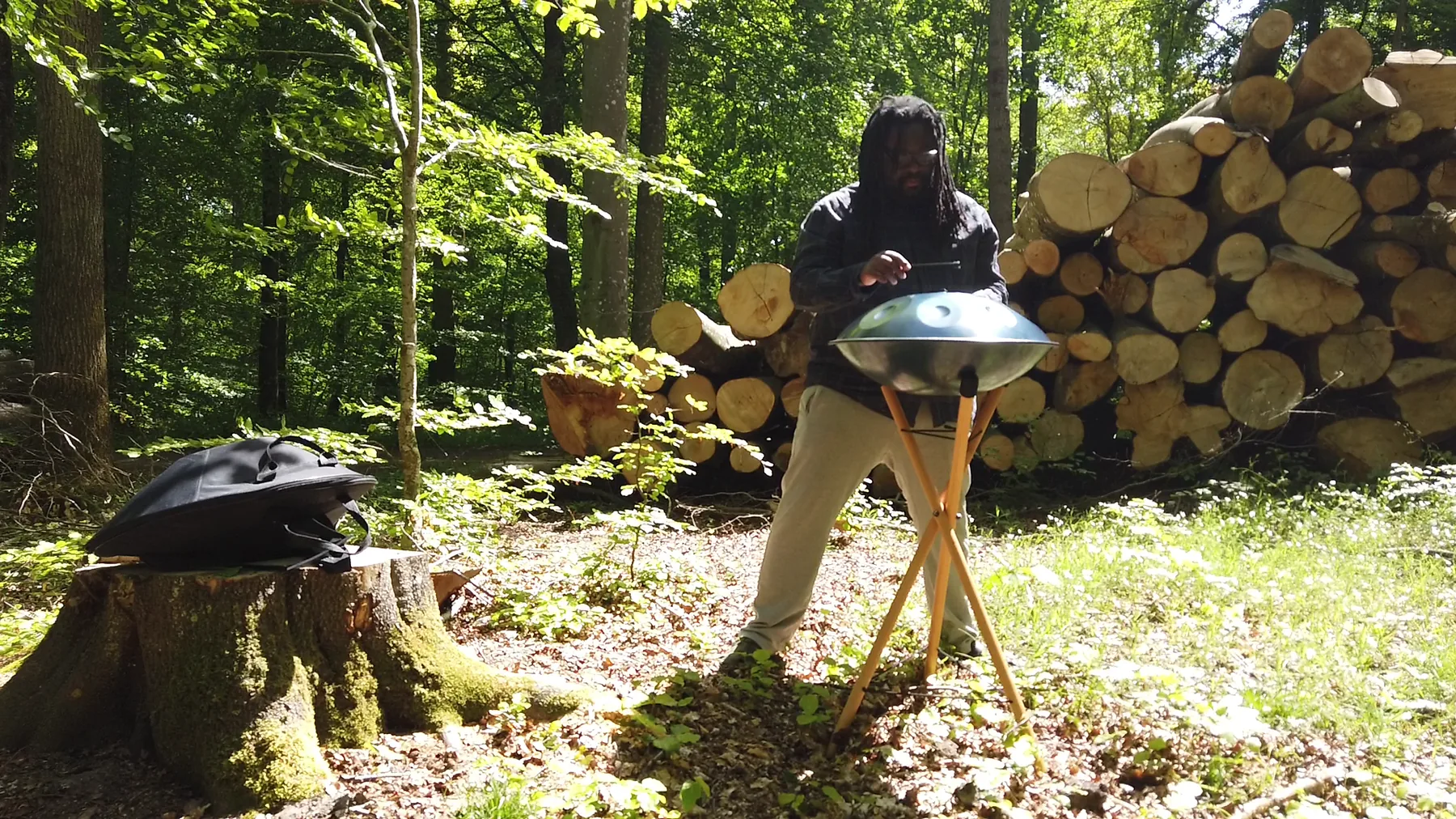
The cavity recalls the principle of a Helmholtz resonator. You can hear this principle by blowing across the mouth of a bottle: the air inside the bottle contributes to the sound.
This comparison helps explain the cavity’s role, but it does not mean you should blow into a handpan. Here, the metal is struck with the hands, and the air inside contributes to the resulting resonance.
The dimensions of each tuned area help distinguish its pitch. Low and high notes do not simply come from different positions: the shapes of their tuned areas also matter.
The International Organization for Standardization recommended A at 440 Hz in 1939 and recognized it in the 1950s. The ISO 16:1975 standard for A at 440 Hz sets this frequency as a standard musical reference.
Choosing a handpan can therefore involve several distinct questions: the pitches in its scale, its tuning reference, and the sound you prefer. Remember that 440 Hz is a concert pitch reference, not the name of a scale.
First playing techniques that let the notes ring
A light strike followed by an immediate rebound lets a note vibrate longer than a finger resting on the metal. A relaxed movement gives the sound room to resonate.
Your finger should leave the surface quickly after striking it, because prolonged contact dampens the vibrations. Precision matters more than force when you want a clear note.
Position the instrument and stay relaxed
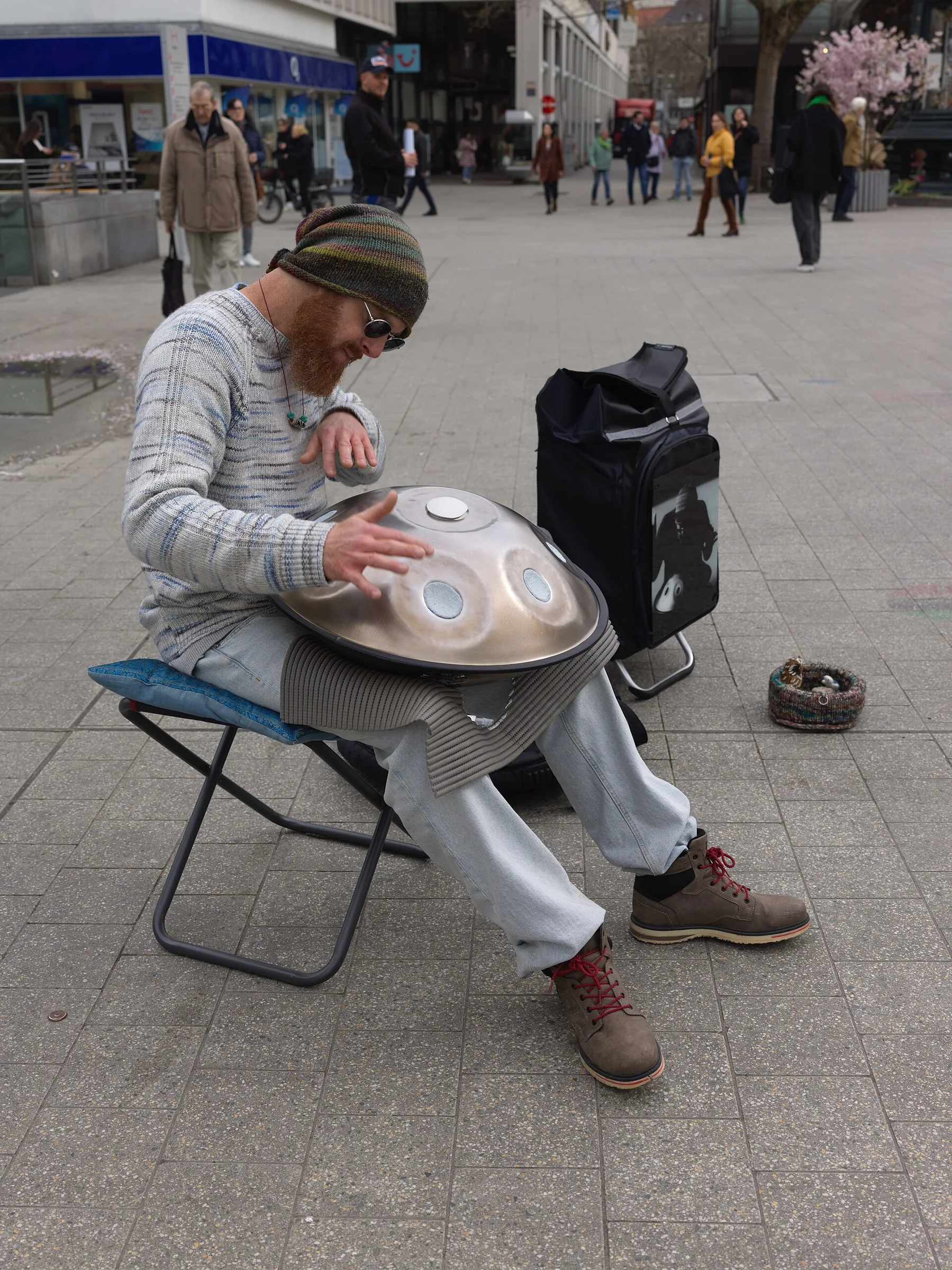
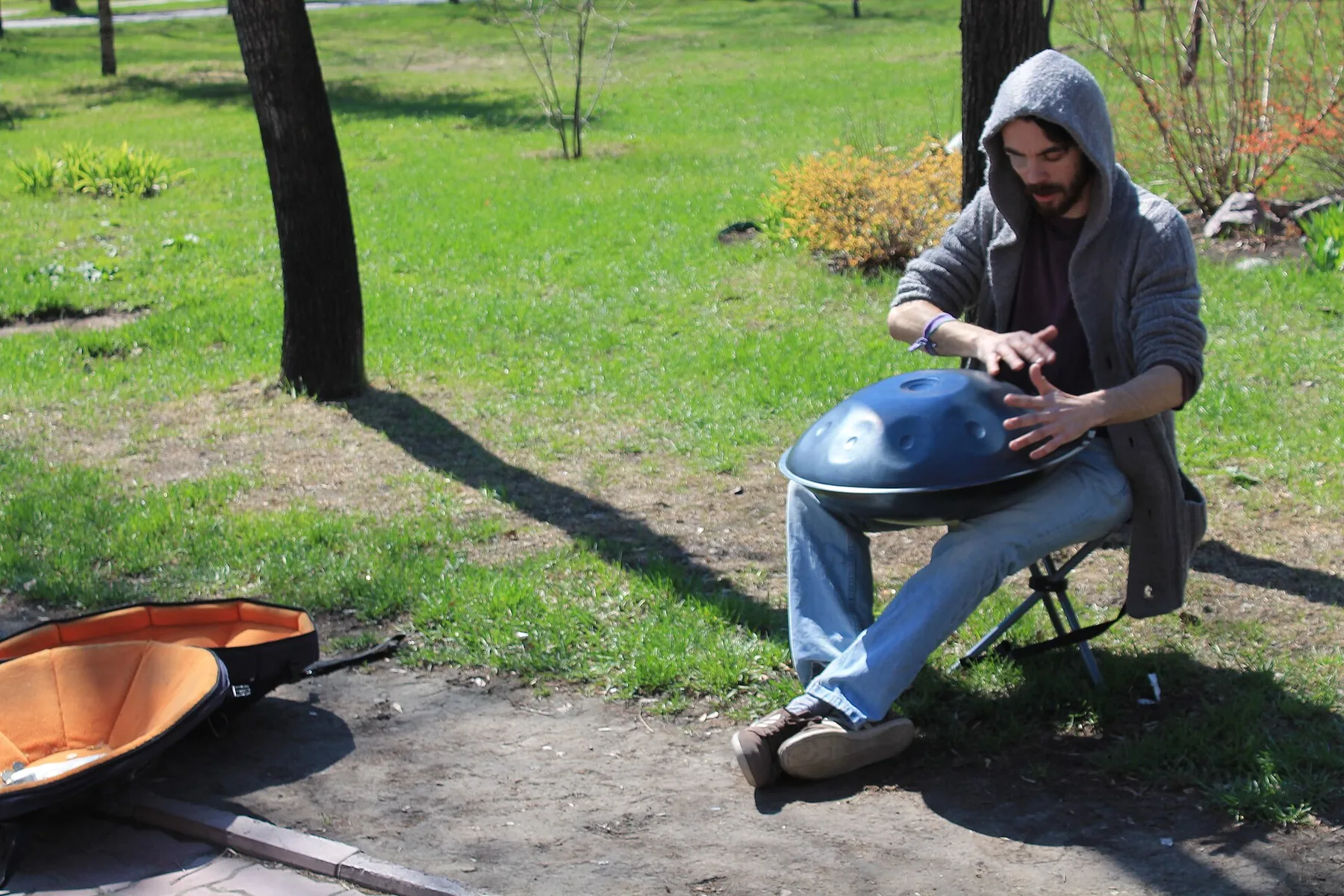
You can play while seated, with the instrument on your thighs, or place it on a suitable stand. To play standing up, use a stand designed to support a handpan.
The Hang is often played on the lap, using the hands and fingers. Keep your shoulders free and your arms relaxed enough to make short movements.
This interdisciplinary approach to musical gesture examines instrumental gestures and musicians’ movements more broadly. In your own practice, pay particular attention to whether your posture lets you strike repeatedly without stiffness.
Let a note ring with a light touch
Most notes are played near the boundary between the tonefield and the dimple. The ding is played in its central area, which forms the upper central note.
Start the movement at your wrist, then let your finger rebound immediately. Striking harder does not necessarily add useful volume and can make your movement less precise.
Begin with one note and listen as it fades. If you can still hear it after contact ends, try another tuned area without speeding up yet.
Add percussive strikes to your playing
The rim and untuned spaces generally produce percussive metallic sounds without a definite pitch. These sounds can mark the rhythm, but they do not replace the melodic notes.
A first practice session can follow four simple steps:
- Settle into a stable position, with the instrument on your thighs or a suitable stand.
- Play one note gently, then listen to its resonance before playing again.
- Let your finger rebound after each strike rather than holding it against the metal.
- Alternate between two notes at a slow, steady pace.
This alternation is enough to feel how your hands move between pitches. If the sound stops too quickly, first check whether your finger is staying in contact with the metal after the strike.
Choose a suitable scale and number of notes
For your first handpan, consider the scale first: it determines which notes you can play and the character of your melodies. The same playing pattern sounds different depending on the available pitches.
A 9- or 10-note layout is enough to learn melody and rhythm. It offers several possibilities without requiring you to manage too many notes at the outset.
The scale determines the available notes
Each scale contains a particular set of notes. Some scales are pentatonic and use five notes, while others may include quarter tones.
A pentatonic scale gives you fewer notes to explore. It may make some patterns easier to remember, while a scale with quarter tones offers intervals that may sound less familiar.
The character you hear depends on the relationships between notes, not just how many there are. Listen to several examples before deciding which musical sound suits you.
A simple layout for beginners
A handpan with 9 or 10 notes already gives you enough to work on melodic patterns and simple rhythms. You can repeat a short phrase, change it, and try combinations of notes without navigating a large keyboard.
D Kurd is a versatile minor scale. It can suit melodies, simple rhythms, and improvisation, making it a common example for a first exploration.
An instrument’s quality cannot be judged by its number of notes alone. Accurate tuning, clear pitches, and how easily you can recognize the notes also matter.
Distinguish the scale from the tuning reference
The scale sets the notes available on the instrument. The tuning frequency provides a reference for tuning those pitches, such as the A at 440 Hz discussed earlier.
Two handpans can share a similar tuning reference while offering different scales. Conversely, the same scale can be tuned using a different frequency reference.
To compare models, listen to several notes in succession instead of judging by one isolated note. If you are unsure, compare scales by listening to their notes rather than choosing solely by name.
Read handpan tablature or numbered notation
In one numbered notation system for a 10-note D Kurd handpan, D marks the ding and the numbers 1 to 9 mark the other notes. This convention helps you find notes quickly without reading a traditional staff.
The numbers identify the notes, while stems show their durations. Symbols vary between scores, so check the key before playing a piece.
Find the ding and the other notes
Tablature shows the notes to play visually, often by indicating their positions on the instrument. A simplified notation system may instead use numbers for notes, with letters or symbols for certain effects.
In this convention for a 10-note D Kurd handpan, D corresponds to the ding. The numbers 1 to 9 identify the other notes, from lowest to highest.
You can practice with a short numbered sequence and find each number on the instrument. A comparable way to read numbers and durations appears in this kalimba tablature with a tutorial, designed for a different instrument.
Read durations and tempo
One stem represents a quarter note. Two connected stems represent two eighth notes played within one beat, while two horizontal beams indicate sixteenth notes, each lasting a quarter of a beat.
Tempo in BPM indicates the number of beats per minute. At 80 BPM, a metronome marks 80 beats in one minute. At 60 BPM, each beat lasts one second.
Durations describe the spacing between strikes, while tempo indicates the speed of the beat. This discussion of tempo and perception explores the distinction between a stated tempo and the speed a listener feels.
To read a simplified score, work in this order:
- Find D to identify the ding in the notation.
- Identify the numbers that represent the other notes.
- Read the stems and beams to work out the durations.
- Check the tempo in BPM before you begin.
At 60 BPM, each beat lasts one second, giving you a simple reference for counting slowly.
Learn handpan on your own or take lessons?
You can begin on your own, take a lesson by webcam, or meet a teacher in person. The best format for making progress is one that helps you practice regularly.
A private lesson costs an average of €40 per hour. This price applies to individual lessons and does not automatically apply to tutorials or other formats.

Available lesson formats
An online lesson with a teacher by webcam lets you receive advice remotely. In person, a teacher can work with you in the same room and adjust their guidance as you play.
Learning independently involves tutorials, scores, and exercises that you revisit at your own pace. You need to choose suitable resources and keep practicing regularly.
The main differences between these formats are how you interact with a teacher and where the lesson takes place. The table summarizes them.
| Format | Interaction with a teacher | Location |
|---|---|---|
| Webcam lesson | Yes, live | Remote |
| In-person lesson | Yes, live | On site |
| Self-guided tutorials | No live teacher | At home or elsewhere |
To explore another form of independent learning, this beginner’s guide to choosing a kalimba explains how scores and tutorials can support practice on a different instrument.
Build a regular practice routine
Plan short sessions you can repeat each week. A modest goal, such as keeping a pattern steady or memorizing a few notes, helps focus your attention.
Work on one main difficulty at a time. For example, you might devote one session to keeping a steady rhythm and another to coordinating your hands.
A teacher can suggest exercises suited to your level, while a tutorial lets you set your own pace. The two approaches can also work together if you are clear about your goals.
From first patterns to steadier rhythms
A few months of regular practice is a common guide for learning the basics of simple grooves. The time varies from person to person: your progress depends on how regularly you practice and what you aim to do.
You can gauge your progress by playing the same pattern again at different times. Listen for a steady pulse and for notes that sit clearly within the rhythm.
Guided learning can help you spot a difficulty you might miss on your own. Independent practice also has a place, especially when you know what to work on during each session.
Choose a format you can follow regularly and one musical skill to work on first.
Settings that reveal the handpan’s sound
The same resonant sound can accompany contemplative listening, a street performance, or a musical ensemble. The timbre combines the pitch of the notes with the instrument’s resonance.
Notes played together may sound harmonious, but they can also create dissonance. The result depends on the pitches combined and how they fit into the music.
Each note can produce a fundamental, an octave, and a fifth. These components enrich the sound, while playing several notes together adds further relationships between pitches.
You can hear handpans in many settings:
- Relaxation or yoga, where music accompanies quiet listening.
- Street performances, which introduce the instrument to people in public spaces.
- Chamber music, where the handpan can interact with other instruments.
- Documentary films, which use its timbres in a soundtrack.
“Soothing” describes a listener’s impression, not a promise of care or a therapeutic effect.
A street performance often blends the instrument’s sound with the surrounding noise. In a chamber ensemble, the other instruments change the contrasts and the handpan’s place in the music.
These differences show why the instrument is not limited to relaxation music. To form your own impression, listen to a handpan in a quiet setting and then in an arrangement with other instruments.
Conclusion
Two ideas are enough to get started: let each note ring and choose a scale you enjoy hearing. A light touch encourages resonance, while the scale determines the available pitches.
You do not need to master sheet music to explore a few sounds. Listen to several scales or try striking an instrument a few times if you have the chance.
Pay attention to the note that makes you want to play again rather than the number of notes available. Take a few minutes to listen to or try a handpan, then choose one note to explore first.