
Goal: provide a complete score and a step-by-step tutorial for playing this hit, suited to both beginners and experienced musicians in France.
This guide covers the equipment, quick tuning, harmonic reference points, and how to read numbers and letters.
You will also find thumb placement, three arrangement levels, and fingering recommendations. We explain the verse and chorus structure, recurring patterns, and ways to achieve a disco and Latin groove.
Practical tips: tuning accuracy, steady tempo with a metronome, common mistakes to avoid, and simple to advanced variations suited to the range of a standard instrument.
Free resources and scores are listed to help you keep learning, including a useful collection of 17-tine sheet music and tablature.
Finally, we suggest articulations, accents, and dynamics to keep the sound clear and faithful to the song. This guide has 16 sections for gradual, effective learning.
Tutorial goals and intended audience
The goal of this tutorial is to offer a clear, progressive method for learning the intro, verse, and chorus on a 17-tine instrument.
Who it is for: curious beginners, intermediate players looking to expand their repertoire, and advanced musicians seeking rhythmic variations and ornaments.
Simple prerequisites: know how to produce a clean sound, understand the standard tine layout, and have some familiarity with number or letter notation. The useful symbols are reviewed later.
Expected results: play the main sections steadily, maintain the groove, and adapt the arrangement to your level.
- Method: break the song into sections, practice slowly with a metronome, and gradually increase the tempo.
- Learning approach: start with the melody, then add simple accompaniment (arpeggios), and finally add syncopation and ornaments.
- Recommended tools: a metronome, a tuner or tuning app, and a smartphone recorder to review your playing.
Benefits: a better sense of rhythm, more accurate thumb technique, and a stronger understanding of harmony in a minor key. Simplified alternatives are provided for difficult passages.
| Level | Goal | Recommended time |
|---|---|---|
| Beginner | Learn the basic melody | 15 to 30 minutes a day |
| Intermediate | Add simple accompaniment | 20 to 40 minutes a day |
| Advanced | Practice ornaments and variations | 30 to 60 minutes a day |
Equipment needed to play a 17-tine kalimba
Before playing, check your equipment to ensure a clear sound and comfortable playing.
Choose a reliable model for a clear sound
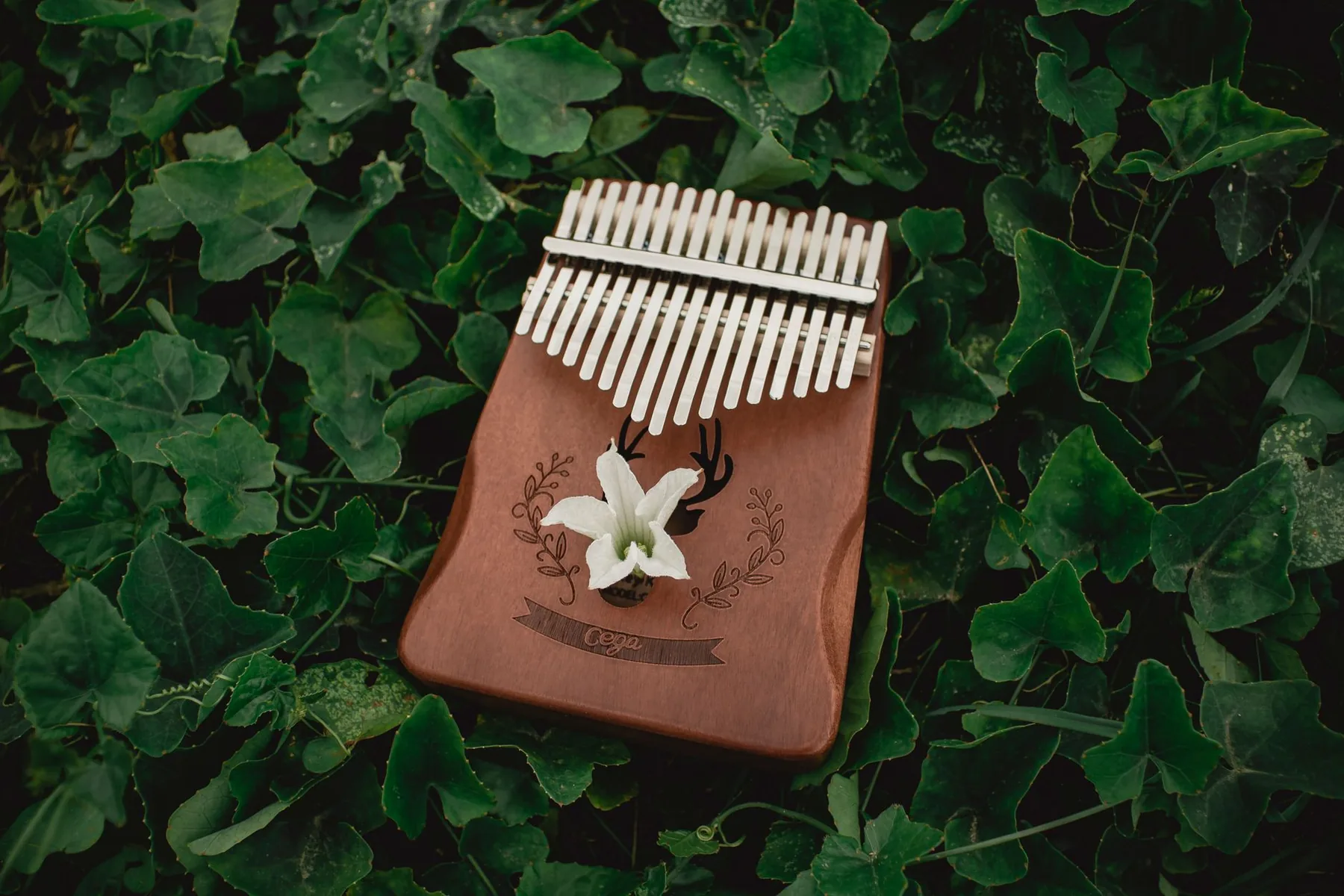
Standard features: a wooden resonator box (mahogany, koa, or walnut), steel fittings and tines, and center markers to guide your thumbs.
Practical tip: look for careful finishing—rounded edges, polished tines, and stable tuning—to reduce unwanted noise and make the instrument comfortable to hold.
Tune your instrument quickly before playing
Stable pitch is crucial: a well-tuned instrument preserves the intervals and lets you play the melody faithfully.
“Check the center notes first, adjust with gentle taps, and listen again until the pitch settles.”
- Use a chromatic tuner (an app works too) and, if you have one, a small tuning hammer.
- Start with the center notes. To raise a note’s pitch, tap the tine toward its base; to lower it, tap toward its tip.
- Listen again, check the alignment of the tines, and clean them with a soft cloth to prevent slipping.
| Tool | Use | Benefit |
|---|---|---|
| Chromatic tuner | Measure a note’s pitch | Accuracy and speed |
| Tuning hammer | Adjust tine pitch | Precise adjustment |
| Metronome | Practice tempo | A steady groove |
Listen to a reference recording of the song before playing so you can match its pitch and groove. Experiment with holding the instrument against your body, too: slight damping changes the timbre and may help you find the sound you want.
For sheet music and resources, see the dedicated score.
Musical guideposts for playing Kalimba de Luna on kalimba
This section explains the key, chord changes, and rhythmic placement needed to play the song expressively.
Key, progression, and feel
Harmonic character: the verse revolves around a minor mode centered on Dm, with a Dm – C alternation that creates a simple, danceable modal pulse.
Rhythm: for a disco and Latin feel, accent beats 2 and 4 and emphasize the melody’s syncopations. Play cleanly and lightly to preserve the groove.
Structure and recurring patterns
The “E.O.U.A.” section introduces Bb and Em7b5, adding color and tension that resolve toward Dm. The chorus briefly moves to Bm through Bm – Em – A before returning to the Dm – C tonal center.
Favor Dm-C ostinatos with alternating drone notes. Color the passage before the vocals with target notes from Bb and Em7b5 to bring out the tension.
- Use the fifth and third of Dm as pivot notes to connect the sections.
- Memorize short, repeated patterns to establish the rhythm.
- Associate each pattern with its chord to anticipate changes and keep both hands steady.
Phrasing tip: pluck each note cleanly with your thumb and observe its duration so the groove has room to breathe. Practice slowly with a metronome, then increase the tempo.
Reading a 17-tine kalimba tab: numbers, letters, and tablature
Reading numbers or letters helps beginners learn faster. Number notation assigns a number to each tine. The principle is simple: each number represents a pitch. This method lets you start without mastering all of standard music notation and makes patterns easier to memorize.
Converting to letters: replace the numbers with note names (A, B, C…). This helps connect what you hear to music theory and identify intervals.
Detailed tablature and how to use it
Full tablature specifies note lengths (quarter notes, eighth notes, half notes) and rests, and may indicate the left or right hand. It helps you align the rhythm and articulation.
- Check the tuning before you begin: an out-of-tune tine distorts how you hear the pattern.
- Print a PDF so you can annotate fingerings and phrase markers.
- Record your attempts to correct note lengths and timing.
| Notation | Benefit | When to use it |
|---|---|---|
| Numbers | Quick reading without standard notation | Beginners and quick review |
| Letters | Connects listening with theory | Learning intervals |
| Detailed tablature | Specifies rhythm and which hand to use | Advanced practice and precision |
Thumb placement and recommended fingerings
Good thumb posture and simple fingerings improve your groove.
Use a neutral position: thumbs slightly curved, touching the ends of the tines, with relaxed wrists. This reduces unwanted noise and fatigue.
Alternate between right and left hands for back-and-forth patterns. Limit jumps made by one hand to keep the groove steady.
Efficient fingerings: assign recurring low notes to the left hand (Dm/C drones) and the main melody to the right. Keep your thumbs near the center to minimize movement.
Use small wrist rotations instead of pulling straight up. The sound becomes softer and control improves.
- Practice connections and accents slowly so the pattern stands out without forcing the volume.
- Suggested routines: Dm scales, Dm-C-Bb-Em7b5 arpeggios, then Bm-Em-A with strict hand alternation.
- Visual landmarks: the center tine and its neighbors serve as a “zero point” for recentering your hand after a jump.
- Mark fingerings on the score to build muscle memory.
- Use economical movements: keep a thumb above a tine if its note returns soon.
Tip: record short loops and compare the clarity of your attacks and the steadiness of the tempo. This quick exercise helps you memorize fingerings.
Step-by-step tutorial: playing the verse
Begin by isolating the bass. Play the root D, then C, at a steady pulse with your left hand. This foundation anchors the groove and makes coordination easier.
Next step: add the minor third F on the offbeats with your right hand. Practice slowly at 60–70 bpm and increase the tempo only when your playing is accurate.
Introduce the vocal melody in two-bar segments. Focus on landing on D or F to establish the key.
- Fingerings: left hand for D/C, right hand for F/A and passing notes, preserving hand independence.
- Place light accents on the first note of each pattern to strengthen the pulse without weighing down the flow.
- Add subtle double notes (octaves or fifths) with the left hand if the sound remains balanced.
If a jump makes noise, recenter your thumb before the next attack. Always let the tines ring, and avoid touching the body during sustained notes.
| Action | Purpose | Suggested tempo |
|---|---|---|
| D/C roots alone | Establish the pulse | 60–70 bpm |
| Add F as an offbeat third | Add color to the ostinato | 60–75 bpm |
| Melody in two-bar segments | Stabilize the tonal landing notes | Gradually increase |
Final goal: connect two complete verse phrases without stopping, then leave a breath before the next passage. Practice short loops and record yourself to check synchronization.
Step-by-step tutorial: playing the “Kalimba de Luna” chorus
To tackle the chorus, first reduce the melody to its essential contour. Practice the sung phrase alone, identifying target notes around B/D, then repeat it until it flows smoothly.
Main melodic pattern on a 17-tine instrument
Contour: loop the sung line over the Bm – Em – A cycles. Focus on short transitions and landing on B or D to stabilize the harmony.
Keep the groove while maintaining a clear sound
Add a light alternating bass beneath Bm-Em-A to support the melody without covering it. If coordination is difficult, prioritize the main line.
- Lightly damp some tines to reduce resonance and bring out the instrumental melody.
- Start more slowly than you did with the verse, then gradually raise the metronome tempo.
- Once you know the phrase, add small grace notes or slides between nearby notes for color.
- Fingerings: right hand for the melodic line; left hand for the B, E, and A roots. Limit hand crossings.
- To return to the Dm-C tonal center, use A as a bridge note before the resolution.
Tip: clearly mark the end of each phrase with a sustained note, release it, then begin the next cycle. Check your timing with the metronome, especially as A leads back to Dm.
Beginner version: a simple melody at a moderate tempo
Start with a simplified version: play only the main verse and chorus melody, without accompaniment, at 50–60 bpm. This makes it easier to memorize and reduces mistakes.
Stay in the instrument’s center range to avoid large jumps. Short movements improve thumb accuracy and stability.
Play long notes at the ends of phrases. They give you time to breathe, check the tuning by ear, and steady your hand posture.
“Play slowly and pluck each note clearly: accuracy matters more than speed.”
- Use a metronome with eighth-note subdivisions to maintain the pulse during sustained notes.
- Use consistent fingerings for each pattern to develop muscle memory.
- Choose short, frequent 10-to-15-minute sessions instead of one long session.
| Tip | Purpose | When to move on |
|---|---|---|
| Very simple variation (Dm drone under the verse) | Preserve the modal character without complexity | After two confident performances at the target tempo |
| Chorus melody alone | Clarify the vocal contour | After several clean, steady repetitions |
| Listen closely to the original song | Match its pitch and accents | Before and during practice |
Intermediate version: simple accompaniment and broken chords
Move to an intermediate version by adding quiet accompaniment that supports the melody without covering it.
Begin with the left hand alone. Play eighth-note arpeggios: for Dm, alternate D‑A‑D; for C, play C‑G‑C. Keep the tempo steady through four-bar cycles before adding the right hand.
Then add thirds to give the line more body. For example, play F over Dm phrases and E over C passages. Play softly so the melody remains prominent.
In the “E.O.U.A.” section, occasionally add Bb as a root and use notes from Em7b5 (E‑G‑Bb‑D) as approach notes. For the Bm‑Em‑A chorus, play broken chords in longer note values (B‑F#‑D / E‑B‑G / A‑E‑C#) to support the key change.
“Lower the volume of the arpeggios when the melody has high notes or ornaments.”
- Control the attack: use an oblique angle and brief contact to avoid metallic noise.
- Favor the left hand for low notes and the right hand for middle and high notes.
- Record a short loop and listen back to correct any timing gap between melody and accompaniment.
Advanced version: syncopation, ornaments, and rhythmic variations
Refine the rhythmic effects by adding syncopation on the offbeats (the “and” after beats 2 and 4). Practice with metronome subdivisions to stay precise.
Decorate the melody with short grace notes, subtle mordents, and slides between neighboring notes. Keep the rhythm crisp: ornaments should enhance the phrase without hiding it.
Harmonizing in Dm and compatible substitutions
To enrich the Dm sound, try borrowing from the Dorian mode: introduce B natural sparingly to create a modern tension.
In the “E.O.U.A.” section, highlight Em7b5 by emphasizing its diminished fifth (Bb) and the ninth (F) as approach notes. This prepares the resolution to Dm.
- Interlocking ostinatos: the left hand plays D‑A‑C‑D while the right hand shifts the melody by an eighth note.
- Over the Bm‑Em‑A chorus, anticipate notes by an eighth note, then resolve clearly to create bounce.
- Close voicings: parallel thirds and sixths in the upper range, with occasional root notes.
“Add very soft ghost notes to create a rhythmic background without covering the melody.”
Cadences: enrich the A dominant chord with the seventh and ninth to color its resolution to Dm. Vary the end of the phrase each time to keep the listener engaged.
| Technique | Effect | Practical tip |
|---|---|---|
| Offbeat syncopation | Strengthens the disco and Latin groove | Use eighth-note metronome clicks and start slowly |
| Ornaments (grace notes, slides) | Adds melodic color | Keep them short and subtle; test them in loops |
| Modal borrowing (Dorian / Bb) | Creates harmonic tension | Use B natural and Bb sparingly |
| Interlocking ostinato | Creates a controlled phase-shift effect | Maintain hand independence |
For a complete score and examples, see the dedicated score.
Practicing tempo: metronome, subdivisions, and consistency
Set a realistic practice tempo and move up in steady steps. Start slowly, check tuning before each session to avoid wrong notes, and print your score to mark fingerings and landmarks.
Use a metronome that accents the beats to establish the pulse. Practice subdivisions (1‑and‑2‑and‑3‑and‑4‑and), then move to triplets if needed to stabilize syncopation and accents.
Work in two-to-four-bar loops. Raise the tempo by just 3 to 5 bpm once your playing is clean and relaxed. Alternate slow sessions focused on accuracy with sessions at the target tempo to strengthen muscle memory.
- Record yourself regularly to spot rushing at phrase endings and attacks that are too weak.
- Try widely spaced clicks (on beats 2 and 4) to develop rhythmic independence.
- Mark the end of each section with a sustained note aligned precisely with the click.
Practical tip: after metronome practice, play along with the original recording to refine your feel for the rhythm. Take very short pauses between phrases to preserve clarity and stamina.
Common mistakes and how to fix them
Here are common pitfalls and simple ways to avoid them.
Skipping tuning: take 2 to 3 minutes before each session to check and adjust the center notes. A chromatic tuner and small hammer make this quick.
Plucking too deeply: this creates metallic noise. Use a gentler attack angle, brief contact, and slightly curved thumbs.
Unsteady tempo: practice short loops with a metronome. Turn on subdivisions and record yourself to find timing changes at transitions.
Accompaniment drowning out the melody: lower the volume of the accompanying hand. Prioritize the sung line and adjust the balance.
- Changing fingerings: mark them on the score and keep using them to build muscle memory.
- Hands drifting from the center: recenter your posture to reduce movement and fatigue.
- Ignoring the harmonic structure: memorize Dm‑C, the use of Bb/Em7b5, and the Bm‑Em‑A cycle to anticipate melodic lines.
- Speeding up too soon: deliberately slow down and raise the tempo in 5 bpm steps after two clean takes.
| Mistake | Correction | Time to spend |
|---|---|---|
| Neglected tuning | Check and adjust the center notes for 2 to 3 minutes | 2 to 3 minutes |
| Noisy attacks | Gentle angle, brief contact, curved thumbs | 5 to 10 minutes of exercises |
| Unsteady tempo | Metronome loops and subdivisions | 10 to 15 minutes per loop |
| Hidden melody | Lower the accompaniment and bring out the melody | 5 to 10 minutes of balance practice |
Breathing and posture: mark phrase endings and release the pressure in your hands for a fraction of a second. Avoid pressing your palm against the instrument’s body so the notes can ring.
Free resources in France: 17-tine kalimba sheet music and tablature
This section presents free scores and downloadable PDFs for players in France. The files are often ready to print and annotate for practice.
The collections include nursery rhymes and well-known pieces: Frère Jacques, Comptine d’un autre été, Fly Me to the Moon, Zelda Lost Woods, Yesterday, Perfect, The Sound of Silence, River Flows in You, Für Elise, Bohemian Rhapsody, and many more.
Practicing different styles improves your sense of rhythm and reading skills. Alternate a simple piece with a demanding one each week to make steady progress.
Comparing number notation, letter notation, and then tablature helps strengthen pitch accuracy and rhythm.
Downloads and organization
- Make a paper binder organized by level (beginner / intermediate / advanced).
- Use printed PDFs for your annotations.
- Warm up with short pieces before your main practice session.
| Type | Access | Benefit |
|---|---|---|
| Online collections | Free, with no registration | Wide range of styles |
| Downloadable PDF | Can be printed | Can be annotated |
| Theme collections | Grouped downloads | Structured progression |
Kalimba de Luna by Boney M: 17-tine kalimba tab
This tablature places each part of the song on a separate page so you can practice step by step.
Organization: verse (Dm – C chart), “E.O.U.A.” section (Dm, Bb, Em7b5), chorus (Bm – Em – A cycles), and final reprise. Each phrase begins with a bar marker and a small chord symbol to make navigation easier.
What the tab contains: sections, fingerings, and chord markers
Standard fingerings: left hand for roots and arpeggios (D, then C, then Bb and the Em7b5 notes), right hand for the main melody. Mark fingerings on the score so the movements become automatic.
Note lengths: an ostinato of steady eighth notes and a quarter-note melody with ties and short rests to articulate the groove. A numbered line, with a letter-notation line below it, makes it easy to switch between systems.
- Separate pages for each section, with clear bar markers.
- Visual chord markers at the start of each phrase (Dm / C / Bb / Em7b5 / Bm / Em / A).
- Notated transitions: a bridge highlighting Bb, followed by transition notes leading to Bm‑Em‑A.
Variations: a simple version with melody alone; an intermediate version with light arpeggios; and an advanced version with syncopation and selected ornaments at phrase endings. Mark a suggested tempo for each section and raise it in steps after two clean takes.
“Tip: briefly damp the instrument’s body at the end of the chorus to make the return to the verse crisp.”
| Section | Suggested tempo | Practice focus |
|---|---|---|
| Verse (Dm – C) | 60–75 bpm | Ostinato, pitch accuracy |
| E.O.U.A. (Dm, Bb, Em7b5) | 55–70 bpm | Bring out Bb and E‑G‑Bb‑D |
| Chorus (Bm – Em – A) | 65–80 bpm | Key change, sung phrase |
Final checks: tuning, metronome, and posture. Review the essential fingerings and check the transitions before playing the whole piece.
Conclusion
To sum up, you now have the harmonic structure (Dm‑C, Bb / Em7b5, Bm‑Em‑A), fingerings, and a clear tab for learning this hit. ,
Progressive approach: begin with the melody alone in the beginner version, add arpeggios in the intermediate version, then work on syncopation and ornaments in the advanced version. Go at your own pace.
Remember the essentials: always check tuning, keep your thumbs in a stable position, practice with a metronome, and observe the indicated note lengths. Listen to the original recording regularly to absorb the groove.
Use the free resources, print the PDFs, record your takes, and share them to get feedback. Return to the score in a few weeks to add new variations and refine your sound.
A quick reminder: choose short, regular practice sessions. The joy of playing, a steady pulse, and personal expression matter more than speed. Explore similar songs to build on your musical skills.